
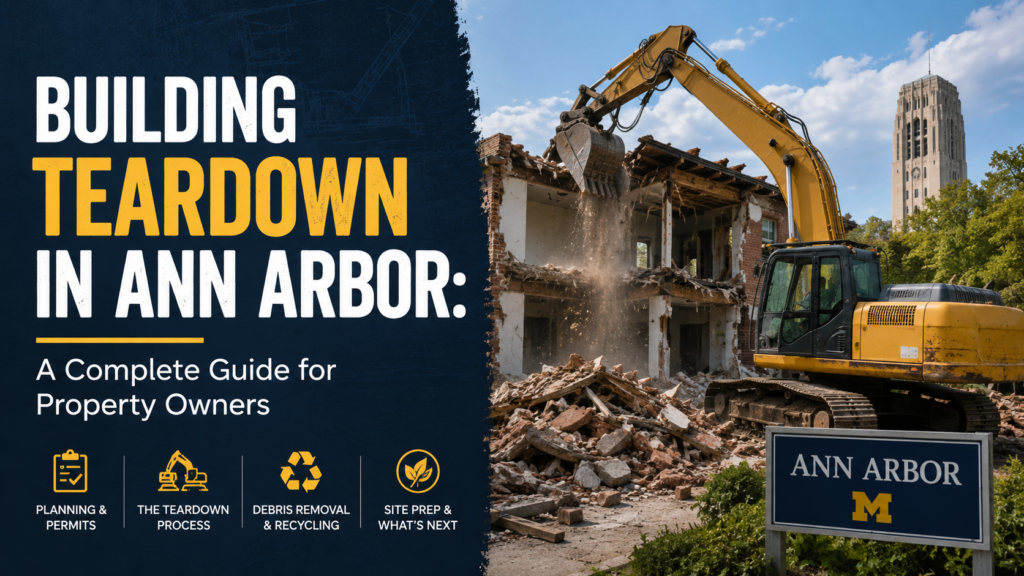
Ann Arbor is one of Michigan’s most dynamic cities home to the University of Michigan, a thriving research and technology economy, a nationally recognized arts and culture scene, and a housing market that has experienced significant pressure as population and employment continue to grow. In this context, building teardown projects are increasingly common: older homes and commercial structures making way for modern construction that better serves current needs.
Whether it’s a single-family home that has reached the end of its useful life, a commercial building being cleared for redevelopment, or a non-conforming structure being removed to allow better use of a valuable urban lot, Building Teardown Ann Arbor projects require careful planning, regulatory compliance, and professional execution.
Why Building Teardowns Are Increasing in Ann Arbor
Several trends drive the increasing prevalence of teardown projects in Ann Arbor:
- Housing demand and land scarcity: Ann Arbor’s land within the city limits is substantially built out, meaning that the only way to add new development in desirable locations is to replace what is already there
- Aging housing stock: Many of Ann Arbor’s residential neighborhoods feature homes built in the 1950s through 1980s that are reaching the point where major renovation costs approach or exceed what new construction would cost
- Changing household needs: Modern households have different space, layout, and energy-efficiency expectations than homes built generations ago, making replacement rather than renovation an attractive option
- Commercial redevelopment: As Ann Arbor’s economy continues to evolve, older commercial properties particularly those in areas transitioning from industrial to mixed-use are candidates for demolition and redevelopment
People Also Ask: Common Questions About Building Teardown in Ann Arbor
What Permits Are Required for a Building Teardown in Ann Arbor?
The City of Ann Arbor has specific requirements for demolition permits. Key steps in the permitting process include:
- Application for a demolition permit through the Ann Arbor Building Safety Office
- Asbestos inspection and abatement documentation for structures built before 1979. Michigan requires an asbestos survey by an accredited inspector before issuing a demolition permit, and asbestos-containing materials must be removed by a licensed abatement contractor before demolition begins
- Utility disconnection verification: The city requires confirmation that water, sewer, gas, and electric services have been properly disconnected and capped before demolition proceeds
- Tree protection plans: Ann Arbor has strong tree protection ordinances, and any trees on or near the demolition site that meet the city’s protected size thresholds must be assessed and protected
Ann Arbor also has specific requirements around disconnection of public water and sewer services, which must be performed by the city itself rather than a private contractor, requiring coordination and scheduling that can affect project timelines.
What Are Ann Arbor’s Tree Protection Requirements for Demolition?
Ann Arbor is famously committed to its urban tree canopy the city has some of the most comprehensive tree protection ordinances in Michigan. For any demolition project, these requirements are significant:
- Trees meeting size thresholds within the project area require a tree removal permit or must be protected in place
- Tree protection fencing must be installed and maintained around protected trees during demolition and construction activities
- In some cases, permits for tree removal require replanting commitments or payment into the city’s tree canopy fund
Demolition contractors working in Ann Arbor must be familiar with these requirements and implement appropriate tree protection measures. Damage to protected trees during demolition can result in significant penalties.
What Is the Typical Teardown Process for a Residential Property in Ann Arbor?
A residential building teardown in Ann Arbor follows a well-established sequence:
- Pre-demolition assessment: Evaluating the structure, identifying hazardous materials, documenting utilities, and assessing tree and neighbor considerations
- Permit acquisition: Obtaining demolition permit, asbestos survey, and other required documentation
- Utility disconnection: Coordinating with DTE Energy, Consumers Energy, and the City of Ann Arbor for disconnection of all services
- Asbestos and hazardous material abatement: If regulated materials are found, completing abatement before demolition
- Material salvage (optional): Removing reusable fixtures, doors, windows, and materials before mechanical demolition
- Mechanical demolition: Using excavators to dismantle and remove the structure
- Foundation removal: Removing the concrete foundation and footings to the depth required by future construction plans
- Debris sorting and hauling: Sorting recyclable materials (concrete, metal, wood) and hauling debris to appropriate facilities
- Site grading: Preparing the cleared site to appropriate grade and drainage for future construction
How Does Ann Arbor’s Historic District Status Affect Teardowns?
A significant consideration for building teardown projects in certain Ann Arbor neighborhoods is historic district status. Ann Arbor has several locally designated historic districts, including areas around Old Fourth Ward, parts of the Old West Side, and other neighborhoods. For properties within these districts:
- Demolition may be subject to review and approval by the Historic District Commission (HDC)
- The HDC evaluates whether a proposed demolition is appropriate based on the historic significance of the structure and its contribution to the district
- Demolitions that are denied or conditioned can significantly affect project timelines and sometimes project feasibility
Property owners planning a teardown project in Ann Arbor should verify whether their property is located within a designated historic district early in the planning process. This is available through the city’s planning and development services.
What Should Be Done with the Site After Teardown?
The cleared site after a building teardown in Ann Arbor represents an opportunity to create something better suited to current needs. Common next steps include:
- New residential construction: The most common outcome of residential teardowns in Ann Arbor, often resulting in a larger, more energy-efficient home
- Multi-family development: In some zoning contexts, teardowns enable the development of duplexes, ADUs, or small multi-family structures that add housing supply
- Commercial redevelopment: For commercial teardowns, new construction aligned with current market needs and building standards
- Green infrastructure: In some cases, cleared sites are converted to permeable landscaping, community gardens, or other green uses
Careful site preparation during the teardown phase including proper foundation removal, utility capping, and grading ensures that whatever comes next has the best possible foundation to build upon.